The Dundalk Democrat reports on local lobbying to have Dunleer Station on the Dublin – Belfast line re-opened.
That would be Dunleer station that was closed by CIE without the requisite notice required by law being given.
The Dundalk Democrat reports on local lobbying to have Dunleer Station on the Dublin – Belfast line re-opened.
That would be Dunleer station that was closed by CIE without the requisite notice required by law being given.
Every so often, something so bizarre comes along that even I take a deep breath.
So it was when I read in the Irish Independent that Irish Rail’s pugnacious PR manager, Barry Kenny, is currently working as a volunteer preparing food for soldiers on the Ukrainian frontline.
Here we have a senior manager in an Irish State Owned Enterprise actively assisting in a war effort against a nuclear power. Someone needs to explain to Barry that Ireland is a neutral State and what that means, in simple English.
One wonders how many Irish Rail employees are volunteering in Syria or Yemen against USA initiated/backed aggression or is State aggression OK if Uncle Sam carries it out?
For the sake of argument, if the war between Russia/Ukraine were to escalate from a proxy war with the West into an actual hot war, how would it look that a senior manager in an Irish State Owned Enterprise was actively assisting in a war effort against a nuclear power?
Let us not forget that during World War 2, when the Free State was neutral, the creamery at Campile in Co. Wexford was bombed by the Nazis, allegedly a “mistake”, however, in all reality, an attack on a food supply for Britain.
Courtesy of the Donegal Daily website, I became aware of the existence of this website, which shows the location of current and former railways on the island of Ireland. They claim that it is also available on the Irish Rail website, but a check of this led nowhere.
The production is reasonable, but only shows the location of the lines and no further details. For a more detailed set of maps of the current and former railways of Ireland, including stations and a page for each of the latter, my railway maps of Ireland can be consulted. The one aspect where this other site is better than mine is that it also shows city tramways, which I have not included on my site.
As a final thought, the article states that the website was developed with the support of Irish Rail. I thought that the State (which Irish Rail is, as a loss making State owned enterprise) was not permitted to fund projects where private capital (mine) has already funded something similar (see above).
Sometime in April 2023, the commemorative stone below appeared at the canal harbour in Kilcock.

I have no idea about who is behind it or why it was felt necessary to note the restoration of the canal harbour at this remove from the actual event.
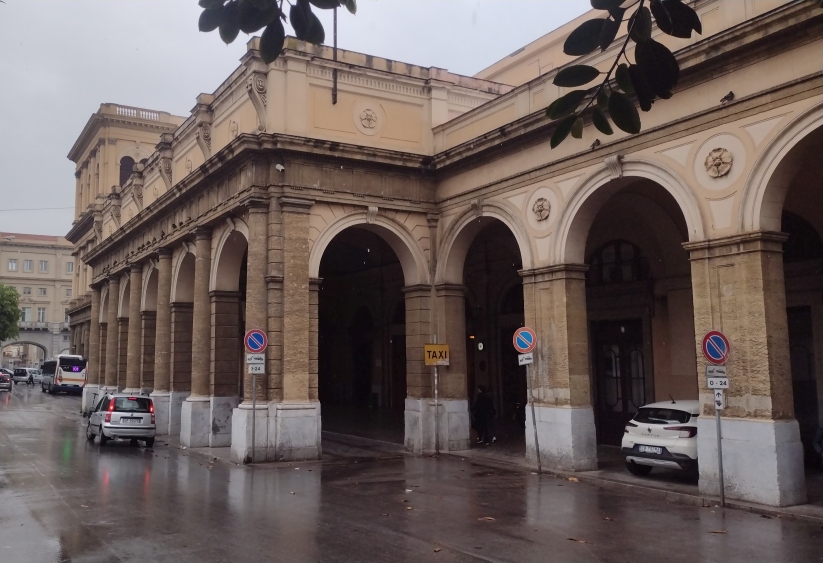
A port cochere is defined as a covered entrance large enough for vehicles to pass through. They were a regular enough feature for public buildings of scale in the 19th century, allowing horse drawn traffic to enter a covered area for unloading.
There is one at Heuston Station, which is a rather squat affair:
compared to that at the train station in Palermo, Sicily. The Italians must have had higher carriages.
I was recently in Rome for the first time (a stopover before getting the train from Rome to Sicily) and noticed that many of the manhole covers in the streets had the initials SPQR cast into them.
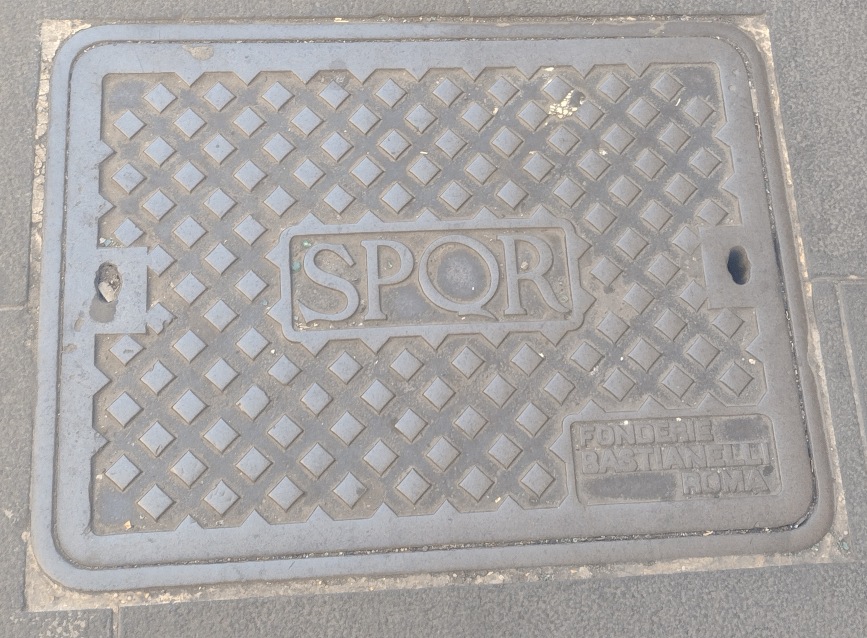
For the uninitiated, this stands for “Senatus PopulusQue Romanus” in Latin, or “the Senate and the People of Rome” in English.
It is interesting to see the use of Latin in modern era infrastructure.
In 2022, a book was published – “West Cork Railways – Birth Beauty and Betrayal”, written by Chris Larkin. Out of print, a revised 2nd edition is due to be launched on 28th May in the Oriel House in Ballinhassig.
I have created a page on the site containing old photos of Castlecaldwell Station in Fermanagh, which have been provided to me by Gabriel O’Connor, son of the last stationmaster at the station.
Many thanks to Gabriel for doing this and allowing me to include these on the site.
I can say with confidence that I know where all “public” railways in Ireland are/were but private industrial/other railways are a different matter as these can be developed and disappear in short periods of time and as such, would not be picked up by organisations such as the Ordnance Survey.
One such line is this one, built and maintained by an individual somewhere in the west of Ireland.
Irish Mist was a liquer produced in Tullamore, Co. Offaly between 1947 and 1985.
Offalyhistory, with the support of Creative Ireland and Offaly County Council, are looking to publish a book on the production of Irish Mist and are calling for those who can provide first hand accounts of working in the production of the drink to get in touch to share this or any other relevant information.
From the Offaly Express:
“Please contact John Flanagan, Ardan Heights, Brian Jaffray or Michael Byrne or Frank Nicholson. Why not email us info@offalyhistory.com or call to Offaly History Centre, Bury Quay, Tullamore.”