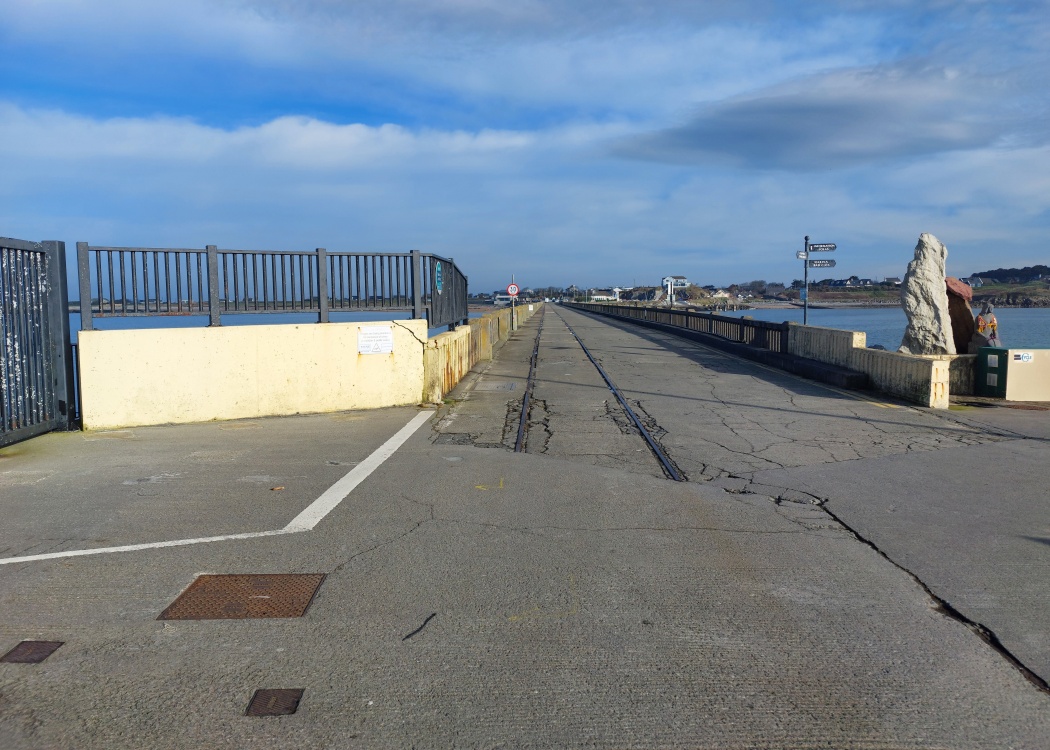
Well known historian Rob Goodbody will be giving a talk on the Bridges of Wicklow to the Roundwood Historical Society on 20th May 2025 at 20:00 in the Roundwood Parish Hall.
There is a charge of €5 for non members of the Society, reduced to €3 for Roundwood Historical Society members.
I was in Dresden over the bank holiday weekend, for the express purpose of visiting the Dresden Danglebahn, sorry, Schwebebahn.
Schwebebahn are suspension railway, of which there are a few in Germany. There is the more famous Wuppertal Schwebebahn, which I visited in 2023 and there is the Dresden Schwebebahn, which is, in some ways, more interesting, being a suspension funicular railway (i.e. there are two lines with the carriage ascending being raised by the weight of the carriage descending).
One aspect of the system caught my eye, more on the basis of ‘that would never work in Ireland’. Shortly after leaving the lower station, the line crosses over a road. With no warning signs or gates, the carriage crosses this road at a height that would enable an accident in the form of a large road vehicle running into it.
The Newry & Armagh Railway (originally planned to be the Newry & Enniskillen Railway) built a line between the two locations in its name. This included the 1,759 yard long Lissummon Tunnel just west of Newry and the Dublin – Belfast Railway.
The tunnel is now on private property and access not officially permitted (I have never been in, but if the owner sees this post, I’d be happy to pay a visit with permission).
As mentioned previously, the long awaited memorial to the Factory Girls in Derry has been installed. I visited Derry at the end of March and took a photo of the new memorial.
H/T to the yaycork.ie website for bringing this to my attention.
The Galley Head Lighthouse in Cork will be open to visit on Sunday 27 April 2025 between 1200 and 1700. For those wandering around the grounds of the lighthouse, there is no charge but a charge of €5 applies for those wishing to climb the lighthouse tower.
Parking is not available at the lighthouse, but a shuttle bus will be running to/from the lighthouse to facilitate visitors.
I finally got around to setting up a ChatGPT account, one of the features of which is the ability to create AI generated images. The issue of copyright in such images is unclear, with advice veering towards copyright not been held by the person who initiated the request.
I asked Chat GPT to produce 2 images and to be fair, it did a middling job.
ChatGPT generated image of industrial heritage in Ireland.ChatGPT generated image of a railway station in Ireland.
Nothing to do with roadside features – just a post to note that my image collection has, in recent days, hit 15,000 railway digital images and 3,000 canal images.
To commemorate this, digital railway image 15,000 and digital canal image 3,000 are below: